We’ve been keeping a secret for the past month.
29 days. I was inpatient again at John’s Hopkins for 29 days. It all started with a usual cardiology followup appt, chest pain, a change on my ekg, and my cardiologist wanting to check things out and get me some sort of relief.

The week before my appointment at Hopkins I was admitted to the hospital that my GP’s office covers because I had chest pain during an appointment and my GP following office protocol. They were in touch with Dr. Martin up at Hopkins for guidance which was “do not Cath her unless her EKG changes or she throws a troponin” and keep her comfortable, I see her next week”.
Unfortunately, My chest pain was out of control, breaking through my spinal cord stimulator. The stimulator increases your tolerance, so this meant it was a really bad episode. My cardiologist and I talked about trying to identify the trigger because I had a month with no pain at all.
Once admitted to Hopkins, they brought in palliative care and pain management, the two pain powerhouses and they tried every option they could think of, IV drips, oral meds, and the only thing that worked was IV Morphine. The attending, Dr. Jones, (who knows my case extremely well, as he presented it at their weekly round table a few months back) agreed to keep the pain relief coming until we figured things out…and then he went off service..and a tool took his place (there is no other word to describe him, sorry!)
Dr. Jones, the week before, had talked about my refractory angina (chest pain that doesn’t respond to cardiac intervention (surgery) or modern medication), so I knew I have a diagnosis. This doctor just chose not to read my file.
One afternoon, after they made rounds, they left my room and left the door open, the new attending saying “why is she even on a cardiac floor and taking up one of our beds”, which both my nurse and I overheard. My nurse advocated for me, saying she is having new chest pain, she has a significant cardiac history, the nurses know her case and most of her care has been on this floor”.
The next day, we were both still mad, so I questioned the doctor and told him “if you are going to talk about patients that way, you should close the door, your head of inpatient cardiology put me on this floor”.
Over the next couple days, I kept saying I was retaining fluid, and my daily weights showed it. I had gained 10 kilos of fluid since admission. But they stopped evaluating me. Mistake #1, no leg checks, no lung or heart checks. They were so focused on letting pain management handle things, they lost focus. #useyourstethescope
During week 3, I began to feel this pain wrap around my chest and it was so unbearable, I was in the fetal position in bed crying. I was also unable to walk to the family room, without a wheelchair. I asked the nurse to walk me on the floor measuring my oxygen and heart rate, because I knew something was wrong. Sure enough, my oxygen dropped to 84 % (should be in the high 90s) and my heart rate jumped to 140 (should be between 80-110, for me). But I was told nothing was wrong with my heart. Really?
I begged for them to move me to another floor or my mom to sign me out AMA (against medical advice). They continued to not listen and my weight continued to creep up. This means only one thing…fluid. They did a chest x-ray which they told me came back fine. #lie
Thankfully, 3-4 days later, they needed the cardiac bed and I was moved to a medicine floor. I told them about the pain and the attending immediately left and went to read the x-ray. It was of such poor quality, it couldn’t be clearly read. He wanted to repeat the x-ray. Within an hour, they did it bedside, which showed something on the x-ray. Now, he wanted a CT scan. Sure enough, I had a pleural effusion. Fluid in the lung. 10% of my lung space was fluid and 100% of my lung was trying to expand into 90% of lung space. #problem

The new attending’s first question, “be honest, were they even evaluating you up there?”…followed by “don’t worry Dr. Martin will hear about this.” They pushed on my leg to check for edema and you could clearly see the indent in my leg, +2/3 of edema.
They explained that I wasn’t able to walk, my heart rate and oxygen levels changed and was in so much pain because of the pressure in my lungs. The attending sat at the end of my bed and told me “you are sick” and that they needed to do a procedure the next day.
Holy hell, Batman. Talk about a painful procedure. The next day, they did a tap, and sticking a needle through my back and into my lung, removed about 350-450 CCs of fluid. That is almost half a liter of fluid they drained off my lung. After it was drained, the doctor explained, I had about 2 more liters just sitting in there. They sent the fluid off for a ton of tests, from everything to infection to cancer. If all came back clear, it was due to my heart.
Really cardiology? We had to go to a medicine floor to realize something was wrong with my heart and lungs? Within 12 hours of arriving on the new floor, we had a diagnosis and a treatment plan: a week of diuresis to get the 2 liters of fluid off. (That much fluid is like carrying a coke bottle full of extra fluid around in my lungs, which causes the heart to work extra hard, which causes more problems). For the first couple days, I was on continuous oxygen. I couldn’t walk one lap around the floor without oxygen.

We were so grateful for the second team. I had an awesome attending, great resident and the best intern. Their care was indicative of the level of care that we usually receive at Johns Hopkins. They each stopped in multiple times a day and always checked in before they left for the day to see how I was doing and to see if I needed anything. I saw each of my docs at least 2-3 times a day, versus the usual one time at rounds.
They agreed to continue IV morphine until we got the bulk of the fluid off and especially for the pain from the lung tap, to keep me comfortable. The attending told me that they weren’t bringing pain management back on, because they were useless. Because they had run out of ideas, pain management’s recommendation was to have me come off all pain meds for 3-4 months to cleanse my system of any remnants of the meds and see if they weren’t working because of a tolerance I have built up.
As the attending put it, “with a diagnoses of refractory angina, that is stupid”. I was finally able to come off pain meds and after 8 days and after voiding 23 pounds of extra fluid, I was discharged home.
Go figure that once we got the extra fluid off, by heart rate returned to normal, my pain dramatically decreased and I could go off oxygen. My heart rhythm was a thing of “sinus rhythm beauty” according to my nurse. (Shout out to my girl Kait, who was the best nurse on the medicine floor. We got into a discussion about music, realized we both like christian music and she shared some new artists with me, which I pulled up on my phone and we listened to as she administered my medications.)

It’s been good to be home, but I came Home with a touch of a stomach bug so it’s been a lot of resting and getting back into life at home. Let’s just say there was one happy dog to see me. #myshadow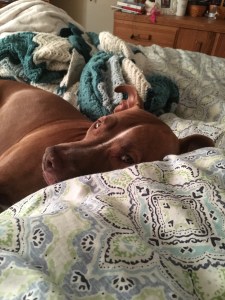
So where do we go from here, first, I am writing a letter to the chief of cardiology and chief of inpatient cardiology to file a complaint against the second attending on the cardiac floor and the team on under him. It was unacceptable care and not indicative of Johns Hopkins. But one thing I’ve learned through all these hospitalizations is that every hospital has bad apples in the bunch. I’m just grateful that my cardiologist is one of the best. He’s made my lipid panel a thing of beauty. This isn’t my first run in with a doctor. #pagingpatientrelations
Secondly, we have to get pain under control. We will do so by managing the stress on the heart, by decreasing the fluid. We have also noticed that my pain is worse when I go through ovulation (probs, TMI, but its all science people). It has something to do with my microvascular disease. I was referred by the chief of cardiology to see a reproductive endocronologist who has worked with cardiac patients to stop ovulation before, so we see him next week. Its been interesting since this began to speak to well respected priests about the options while staying in line with Church teaching. Its pretty simple and straightforward as I am not married right now.
Third, I have to work hard at losing weight. They are giving me until December to lose as much weight as possible before being reassessed for bariatric surgery. The hope is that I can lose the weight by myself and not need the surgery. I need to lose the weight in order to be put on the list for the transplant.
Speaking of which, where does that stand? Well we started the process of the transplant by having an initial conversation with the transplant team and they have spoken to Dr. Martin and the Heart Failure Bridge Clinic at Hopkins, but we are still looking at least about a year before I would probably be evaluated fully and my case reviewed to be put on the transplant list.
I am so grateful that my parish has continued to include me in the prayer intentions at Mass. I know mom has been asked and people have mentioned that they notice my name on the list, the short and skinny of it is that my bad heart is just struggling. The damage from the heart attack is that it doesn’t relax like it should, which doesn’t allow the blood to flow like it should, which leads to the fluid buildup and pain. We try to control it allwith medication, but it causes stress to my kidneys because of all the diuresis. Unfortunately, my kidneys and heart can’t seem to find the right balance. Decrease diuretics..retain fluid…unhappy heart and happy kidneys. Increase diuretics….lose fluid..unhappy kidneys but happy heart.
We all have work to do on our health, so I hope this cautionary tale prompts you to do one thing this week for your health…
Speaking of which, its national cholesterol education month, so I encourage each of you to ask your doctor to run a lipid panel. This is a simple fasting blood test, which should be run every 3 months, especially in those with heart disease. It gives your doctors an easy look into your heart health. Its pointless to say now but had mine been checked regularly and at a younger age, I would have been started on medication and if caught early enough, probably avoid a heart attack. #mygenesgotme
The doctors also encourage families that have a history of heart disease, especially prematurely, have young members tested earlier than usual. Doctors have told me to encourage my younger cousins to be tested now, due to the strong familial nature of my high cholesterol. Its a simple test, it barely even hurts.
Phew, if you made it this far you win the golden prize. Its in the mail 😉 Thanks for listening and as always keeping us in your prayers. We couldn’t do it without you. Please give us a few more days to re-emerge into life and back into a routine. Its been a tough ride for us and a bumpy road this past month.
We didn’t share what was going on this time, because I emotionally was not in a place to share. One thing we have learned through all of this is that when it comes to being a support for someone going through something (lets face it, we all have something in our lives), it cannot be about us.
- Did you offer to help us out and we said no? Maybe we didn’t know what we needed
- Did you write and never get a response? Maybe it was because mom was trying to work and advocate for me as I wrestled with pain and slept off all the pain meds. We both have our limits.
- Did you let us know of your prayers and we never said thank you? Maybe it was because all the prayers we could pray each day, were thank you Lord for another day.
- Did you do our laundry and all we said was thank you? When what we really wanted to do was kiss your feet for bringing us clean underwear.
- Did you pray without knowing the details? I know God knows the details and the prayers of your lips are the ones he hears and answers all in his time.
What you are able to do for us, has to be enough. It has to be enough for us, when we are going through the challenges, a simple text, an email, a phone call, an impromptu dinner, has to be enough for us to remember we are loved, supported and cared for.
And what you do for us, has to be enough. Whether its a prayer, a rejected offer, a text, dinner, must be enough. We all want to do more, but it has to be enough. We must empty ourselves of ourselves and our own desires. Its what I have learned from my experience when I try to help others, it isn’t about the acknowledgement, the kudos or the accolades, its about loving that person enough to love them just as they need to be loved.
I was thinking about the past month I spent at Hopkins the other day and my cousin sent me this post (hi, Katherine!) and it explained things perfectly:
“Illness sometimes ruins our plans and every now and then heartbreak sneaks into our soul and takes our inner joy….I am not promising that God won’t give you more than you can handle. What I am promising you is that God won’t give you more than He can handle”.

 Victory of the heart